

Răcoasa Town Hall is implementing the project “100 Years of Heroism at Mărăști”, financed by the European Agricultural Fund for Rural Development. The project aims to establish the thematic route “100 Years of Heroism at Mărăști”, a memorial route of the “Battle of Mărăști”, a battle that took place between July 9-19, 1917, during the First World War, on the Eastern Front.
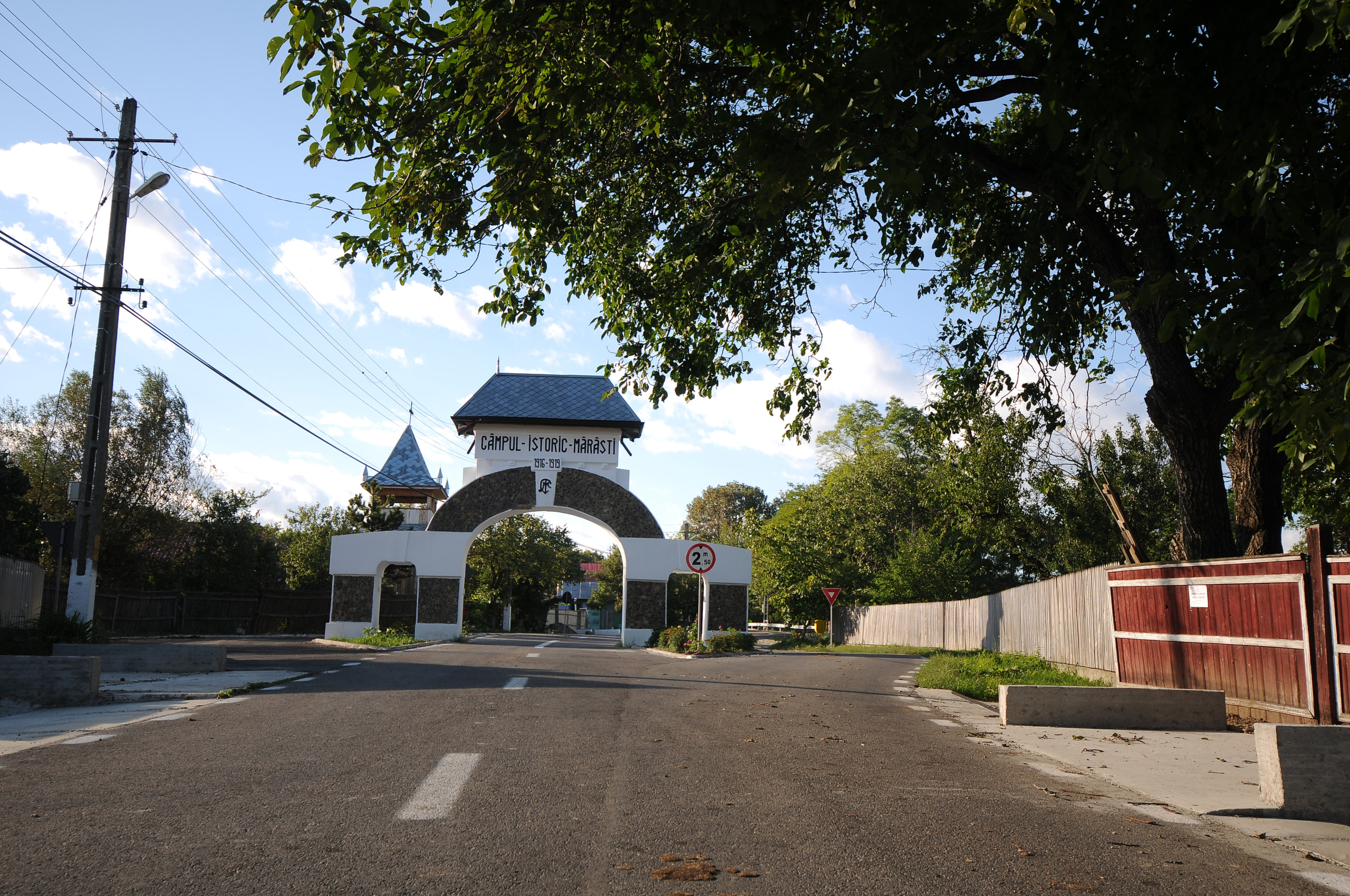
The memorial thematic route created on the Mărăști Battlefield highlights both the strategic-military fortifications located in the Mărăști area during the First World War, and the edifices built in Mărăști village during the interwar period, as a result of the initiative of the “Mărăști” Society, founded at the initiative of the Romanian commanders from the 2nd Army, those who took part in the battles in the Șușița basin in the summer of 1917.
Regarding the military constructions from the First World War, tourists can visit the place where Marshal Averescu’s Observatory was located, as well as a German fortification (casemate) that has been preserved intact in Mărăști village.
At the same time, along this thematic route, one can visit the most important achievements of the “Mărăști” Society, respectively:
- Mărăști Mausoleum – Historical Monument Code LMI: VN-IV-A06632;
- Bust of Marshal Alexandru Averescu – Historical Monument Code LMI: VN-III-m-B-06585;
- Mărăști Triumphal Arch;
- Queen Marie School;
- Mărăști Water House;
- Power plant;
- “Dormition of the Mother of God” Church;
- Wayside cross;
- 14 houses built by the “Mărăști” Society.
Tourists can also enjoy the special beauties of Mărăști village, as well as the traditional local culture and the local cultural heritage.
Mărăști Mausoleum

On June 10, 1928 (old style, ed. n.), the inauguration of the Mărăști Historical Field took place, a large-scale event, on which occasion Queen Marie laid the foundation stone of the Monument-Crypts, the place where the Mărăști Mausoleum stands today. The festivity, which was preceded by the inauguration of the village church, was attended by the Crown Prince, Regent Nicolae, His Eminence Pimen, Metropolitan of Moldavia and Suceava, Marshal Alexandru Averescu and General Alexandru Margineanu, other members of the “Mărăști” Society, delegates of the General Staff of the Romanian Army, delegates of the Union of Reserve Officers, representatives of the regiments that fought at Mărăști, as well as inhabitants from the localities of Putna County. The Commemorative Act that was buried at the foundation of the Mărăști Mausoleum contains the following text:
“Today, June 10, 1928, the foundation stone of the crypts built by the “Mărăști” Society was laid on the very battlefield and on the place where, between July 22-27 [old style – ed. n.], 1917, under the command of General Alexandru Averescu, commander of the 2nd Army, the fierce, glorious and victorious battles against the German armies were fought and the enemy front was pierced by the 3rd Division, commanded by General Alexandru Margineanu, for the eternal rest of the holy remains of the Romanian nation of thirty-five thousand brave men, fallen for the country in the Battle of Mărăști and its surroundings, and so that the memory of the great sacrifice brought to the happiness […] of the homeland by their predecessors may be forever alive in the souls of their descendants, and to preserve in them the eternal examples of bravery, of love for the country and the nation, which have always been the strength of the Romanian people and have kept them fearless in the face of dangers and a wall of stone against the enemies of the ancestral estate”.
The great battle

In Mărăști village, located on the left bank of the Șușița River, a mausoleum was erected that shelters the bones of the Romanian heroes fallen in the Battle of Mărăști, in the summer of 1917. History should put the great victory at Mărăști in the first place because this offensive was the bridgehead on which the decisive offensives at Mărășești and Oituz relied. The battles of Mărăști, Mărășești and Oituz amazed even the adversaries, with the way the battle plan was conceived. On July 22, 1917, from the heights dominating Mărăști, the attack of the Romanian army against the German troops began with the aim of encircling and destroying the 9th Army through an offensive in the Soveja basin area and another attack in the direction of the lower Siret at Nămoloasa, an operation which was however abandoned.
Eight hours of bombardments created 12 breaches in the rows of barbed wire. Under the cover of darkness and masked by the terrain, on the morning of July 24, the Romanian infantry began the assault with bayonet fighting, repelling the German forces. By August 1, the front was broken over a length of 35 kilometers, advancing about 28 kilometers, 30 localities and a territory of approximately 500 square kilometers were liberated. It was the most successful Allied military operation of 1917, the victory at Mărăști contributing enormously to raising the morale of the soldiers, but, in the 10 days of fierce fighting, 1,469 soldiers perished and another 3,052 soldiers of the Romanian 2nd Army were wounded.
“I have, however, firm confidence in the success of our troops on the front of my Army. I am convinced that the action starting today will be a title of glory for our soldier and of pride for the country. We are measuring ourselves, in almost equal conditions, with the best soldiers in the world” – wrote Marshal Averescu in his memoirs.


The church in Mărăști village was among the first objectives bombarded by the Romanian Army in the offensive of July 22, 1917, its steeple having been transformed into an observation post of the Austro-Hungarian Army.
“I make a vow now, in the face of death […], that if God helps us gain the victory, the church of Mărăști village, which our cannons are destroying, I will rebuild it as no other has been more beautiful, and I will dedicate it to Saint Mary Magdalene, which is also the day of our Queen Marie”, General Margineanu, commander of the 3rd Division, told the military priest on the very day of the attack.
On July 10, 1928 (old style, ed. n.), Queen Marie was to inaugurate the new church… rebuilt at the initiative of the “Mărăști” Society.

One of the great achievements of the “Mărăști” Society was and remains the “Queen Marie” School. Because the children of Mărăști went to study in Răcoasa village, at a distance of 5 km from the village hearth, the first concern of the Society was to provide them with an acceptable space for their school education. For a start, one of the rebuilt village houses was transformed into a school, which began functioning as early as 1919.
In 1920, the construction of a school building began, corresponding to modern requirements, finished in 1921 and which bore the name of the “Queen Marie” Weavers’ School. The school had 4 large classrooms, where up to 200 students could learn, and a large vestibule for recreation in winter. The “Mărăști” Society also provided the furniture for the school. Initially, the schoolmaster was nun Magdalena Iuga, paid by the Society, monthly.
MĂRĂȘTI – AN HONORED PROMISE
